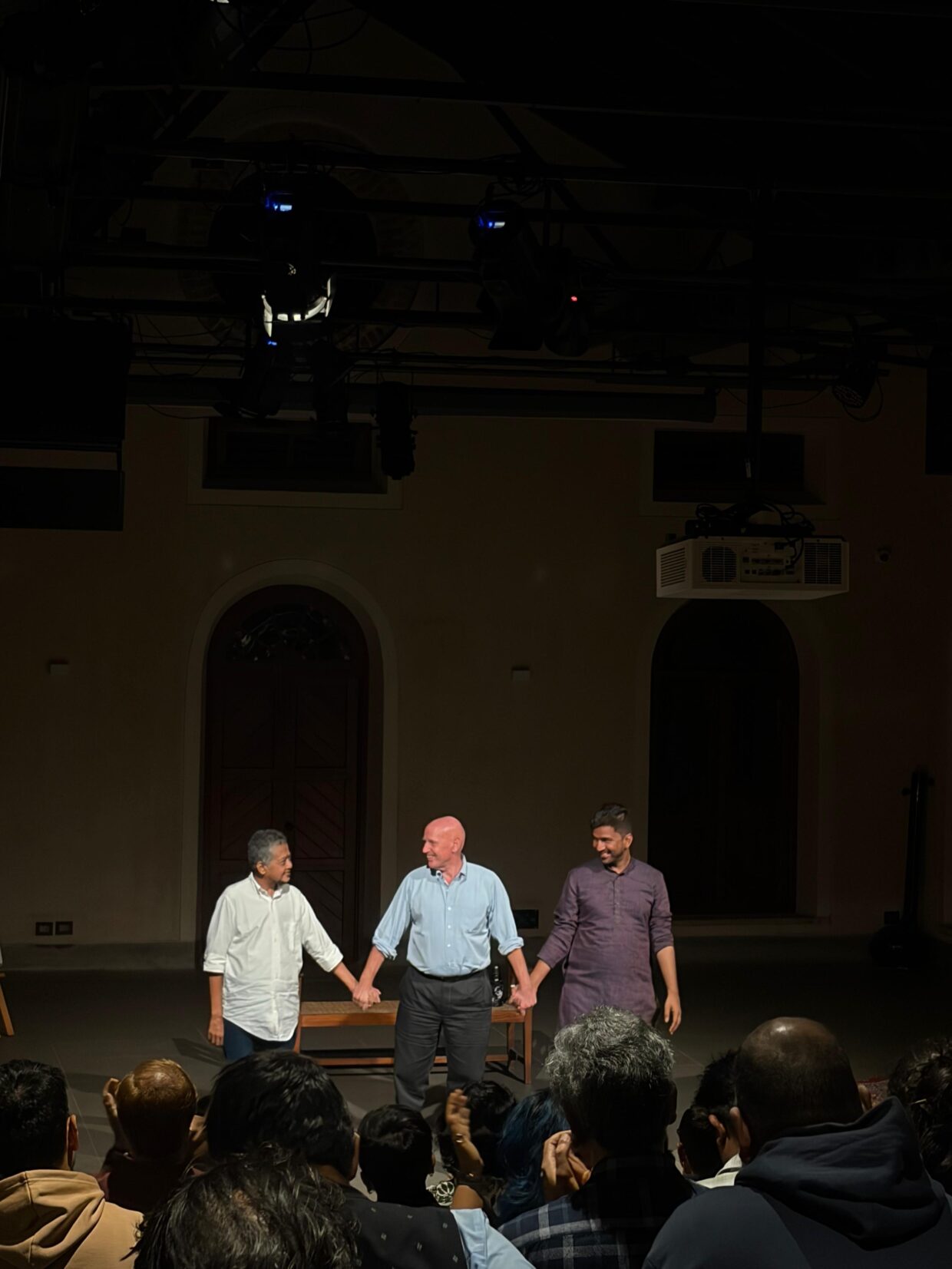
At various points when Rumi Harish sat down during his performance titled ‘Journey from A to E’ the audience at Sabha Blr pulled themselves up a little, craning their necks so as to not lose the view. Rumi became the hypnotist’s pocket watch and we the hypnotised.
In the performance, we are taken through moments in Rumi’s life that shaped his identity as an artist. There was an uncanny feeling that I was not watching a one-man play, but a concert.
At the age of 47, Rumi announces his decision to transition, his father says in a Telugu-Kannada, “Od amma, oddu, beda ma, naavu badakiro thanka ad yella beda, nadiyalla”. We are all watching this scene again in the play, and Rumi delivers this dialogue with such clarity that for a moment he is transformed into his father. Then he walks across, and responds as himself, “I just can’t wait! Till you die.”
There is music in these dialogues. This is thanks to the Bruce Lee-esque training Rumi went through for most of his life. In an interview with New Indian Express, he recalls, “My first guru made me sing one composition for the whole year, everyday I would go and sing the same thing again and again. There was no mercy.”. It was also during these sessions that he began to learn about music in the everyday. Like the street vendors of Bangalore who have a beautiful range and their deft use of voice which lasts them a whole day without strain. He swims in and out of Kannada, Tamil, Hindi, Telugu, and even Malayalam throughout with the ease of an olympian.
Later, we see a jubilant Rumi announce that “I finally got the body I desired”, everyone clapped and hooted. Then we see him carry himself to his “lover”, the Tanpura that sits waiting at the right corner of the stage. We see him touch it with a familiarity that brings to mind a human body — Lover. “I’m back” he says, with a voice deepened by testosterone, “Changed body, changed voice, it’s just like how you change your strings.”
We are eager to listen to him sing with this new voice, but are instead taken through a series of coughs and missed notes. Everyone laughs, and then we are led to the harrowing realisation that his music has turned its back on him. “Let’s try A, we’ve practiced it for hours and hours no? Let’s try A,” He coos to an unwilling lover. He returns again and again to the Tanpura, “Let’s try again, Please ya, help me”, only to receive the same response, or lack thereof. Rumi’s voice takes on a poignant rasp at this moment. An artist’s world implodes and we witness that implosion with disturbing clarity.
So he turns his back on Music as well. “Ohoo isht yella kobu torsidre nadiyalla” he says. And begins to explore other art forms, so what if his lover screwed him over, there’s plenty of fish in the sea. He paints and he writes poetry, and he dedicates hours and hours to them. Young Rumi’s discipline is still going strong. But the music lingers. I am sitting here in the audience hoping for it to return, a piece, a bite, something. I touch my voice box to reassure myself it’s still there. The moment after is a stab, it punctures my pity and forces me to look again at voices.
What constitutes our idea of a good voice and a bad voice? Classical music offers us definitions that are usually reflections of caste and gender anxiety. Throughout my childhood, I had assumed that only certain kinds of people could play music: people from vegetarian houses that emanated the smell of agarbati with pooja songs playing in the morning. It was only in my fifth standard, when I heard that there was something called a guitar class that I realised there were other kinds of music.
This guitar moment for Rumi comes in the form of his friends. Many of whom reassure him, one particular dialogue uttered by a elderly Hindustani musician stayed with me: “neen bar aya illi, naan helkodthini, voice transition yeng madadu antha nan helkodthini, neen aad ayya,” He says this in an old man drawl that makes you want to hug him.
What follows is a dazzling and, to register my complaint, a short rendition of a Vachana by Allama Prabhu. In that brilliance you see this new voice, fit snugly in between the binary of a male voice and a female voice like a harmonium key — revealing for a brief moment the infinite possibilities in music. The renowned Hindustani vocalist, Kishori Amonkar, famously said that “To obtain knowledge, one needs to adopt an attitude of total surrender”, and in that way she became music itself. We see Rumi too become music for a moment.
I’m reminded here that to notice beauty is also an art form. This is why reading is as much literature as writing, why listening as much music as singing. Rumi Harish often says “In a world with vertical stratification, horizontal vision and imagination is a revolution”, It was a joy for this writer to witness this come to life.
Bangaluru, 6th January.


Pranav VS
Latest posts by Pranav VS (see all)
- What is a sakkath voice? Ask better questions, says Rumi Harish - 9th January 2026
- Kaara-saaramana oru Kulambu - 23rd August 2023
- Two notches, with love - 21st April 2021