This essay by Vibha Bhat was awarded a special mention at the SJU Prize for the Personal Essay 2026. The theme for this year was ‘The City, from a Bus’. The judge was Jayapriya Vasudevan, founder of Jacaranda Literary Agency. This is what she had to say about Vibha’s essay: “I found Vibha’s ‘City of Dreams’ promising and some sentences stood out in particular for me. “Embarrassment is transformed into belonging” and “The bell rings. And every time it rings, I belong again” she says.”
It begins with a ring.
A clear sharp sound passes through the humidity of the environment, creating thirty human
bodies into one piece of rectangle moving towards the conductor who has swung his arms up to create a straining motion with the cord, making the bus inhale and exhale back into the traffic. “Aage door se utariye madam!” He speaks and the choreography begins, people start moving their arms to make geometric shapes by folding their elbows, lifting their bags, coming together for just a short period of time to create a temporary partner.
I am standing in this geometric design, gripping a steel bar that has been rubbed smooth from years of people holding onto it and outside there are buildings coming and going as if I can’t hold on to this thought very long.
This is how the city of Mumbai teaches you, no soft touch, no cruel words but a rhythmic rush pushed upon you.
At some point in time, if you need a point of reference, in 2024, there was the very first arrival. It took place on a flight from Bengaluru to Mumbai. It also was my first time travelling alone. I arrived at the airport three hours before the flight to try and compensate for my tremor about flying. While waiting in the airport lounge, I ate like Durvasa Muni from the akshayapatre, not leaving a grain out. I ate piles of pasta, samosas, and brownies because it
was all for free. The airplanes departing from the airport seemed very sure of themselves just as I attempted to imitate their self confidence, hiding my nervousness behind the non-stop eating.
However, my experience of arriving in Mumbai didn’t begin at the airport. It began outside of the airport when Anna gave me a big hug and grabbed my suitcase from me and said that we had to catch a bus. We took the bus. We started running to catch the bus, while we were running there, we reached a point where we came across an Executive of the Chalo Bus. The person told us that we were at the wrong bus stop. Anna insisted that we were at the right
place based on what the airport personnel told him. The bus conductor shook his head at us with all the seriousness and credibility of someone who has witnessed thousands of travelers make the same mistake. In his voice, you could sense the frustration, “Arre bhai, unko ek kaam hai sahi bus stop batane ka. Woh bhi nahi kiya. Kitni baar samjhaya!”
Mumbai scolds you like family, but the city does not disown or abandon you. Either way, we boarded the bus.
—————————————————————
The bus system became my introduction into Mumbai.
A137. A125. A11. For me, these numbers stopped being routes and turned into emotions about where to go and how to navigate after I get there. After I left the Tata Institute of Fundamental Research (TIFR), I walked over to the bus stop at Navy Nagar. When I first took the bus by myself, I gave the conductor a hundred rupee note to pay for my ticket worth five rupees.
The conductor stared at me for what seemed like an eternity before he said, “Kya madam, paanch rupai ke liye sau rupai?”
My neighbours in the bus started laughing. A man looked up from his Marathi newspaper. A woman with jasmine in her hair smiled at me. I wished I could melt into the vinyl seat covered with scratch marks, but instead, I was embarrassed, shook my head and frantically searched for change.
In Mumbai, there is no escape from embarrassment, embarrassment is transformed into belonging.
The conductor pulled coins from his leather pouch, counted them in record time, and handed me a ticket that was as thin as tissue paper, the city generates maximum movement with minimum documentation.
—————————————————————
The relentless self-editing of Mumbai continues outside my window.
In Vile Parle, the flyovers twist together in chains. There are tiny homes leaning next to the high rise glass buildings. A laundry rack in front of corporate signage. The city is vertical, it mixes hope with survival.
A Bentley drives by a man sleeping on a bench, and next to a corporate executive displaying freshly pressed linen stands a fisherwoman who has created an entire architecture after carrying baskets on her head. Mumbai has opened its hearts to everyone. It coexists and they all share the same view.
Through the bus window, I once saw a child running with balloons in his hand, and behind him was an advertisement for a luxury apartment that started at 12 crores. They didn’t negate each other, they simply thrived together.
An understanding of Mumbai will come through observing its animals.
Colaba is a neighbourhood full of cats that are thin and yellow and regal and slide beneath scooters, curl up next to art galleries, sleep on the folded tarps just outside Jehangir Art Gallery, as artists hang their canvases less than a foot away from sleeping cats. The cats are not forbidden to hang out at these locations, they are home.
I once stared from my bus window while travelling to Fort, towards Regal Cinema and saw a cat sitting straight up, like a soldier guarding the entrance of the theatre. As patrons exited the theatre, the cat was blinking and giving an indication to just move faster.
Dogs on Marine Drive have collars with phone numbers. They are community dogs. They do not approach you in search of food, rather, they patrol they just lie down and sleep feeling at home. The dogs sit with their backs to marine drive, like old men retired from the workforce. The joggers and the couples will bypass any group of dogs with respect and will sit down next to them without fear. These dogs are part of the family. Even though Mumbai is very chaotic, there is space for everybody, dogs, cats, humans and all.
There is something profoundly moving about a city that assigns belonging to the voiceless.
—————————————————————
One day, we took the TIFR bus to go to Marine drive.
At night, Marine Drive is not noisy, it hums. The ocean doesn’t crash extravagantly, it breathes. The waves take in the fatigue of the city and then release salt into the atmosphere.
Their rhythms have been established in the context of the traffic patterns, the towers that
define our horizon and the architecture that lines the street along Marine Drive. When the tide comes in, the ocean throws itself against the rocks in a frenzied manner, producing a fine spray of salt on your skin. When the tide goes out, it goes out without any drama, exposing dark rocks that appear that were hidden for a long time but are now exposed for everyone to see, as if the water briefly revealed those secrets and then reconsidered them.
As the Queen’s Necklace emerges from the darkness, one light at a time, it is as if the city is remembering itself. The arc of lights around this city’s coastline is like an opening and closing bracket to the restless story of Mumbai. Throughout the promenade, couples are sitting closely together as they talk to each other, their voices gradually faded into the breeze. Joggers pass by, each in their own rhythm, moving to and from as they work out.
In this place, the ocean does not make any distinction between joy or sadness, it will take in both with open arms. I have seen young people yelling into the ocean wind and old men sitting silently staring out to sea, seemingly waiting for answers from salt water. The taste of the air is slightly salty, polluted and alive, with your hair standing on end, clothes stuck to your body. Regardless, you stay because the ocean offers a brief feeling of being part of something that lasts forever.
I had chocolate ice cream on a very sticky day, where the ice cream was melting faster than I could get it off of my fingers. The sweetness of the ice cream was immediate, pure, and seemed like it came from childhood. We wandered down Marine Drive with no destination.
Freedom in Mumbai is not isolation. It is permission.
After we arrived at the Churchgate station, Anna had ecstatically returned with a vada pav wrapped in thin paper with oil already beginning to soak through the layers. When
Churchgate is at peak hour, it is just so full of people. But it’s also full of “Arre jaldi chalo bhai”. The local trains enter with a loud metallic sound that causes their doors to open and fill with people before the wheels stop rolling. People are moving in waves toward outwards simultaneously with their briefcases, backpacks, dupattas, and ID cards being pulled on.
The announcement system at Churchgate is continuously proclaiming messages in three
separate languages at an urgent rate. As you try to get your bearings in a tidal wave of people, you will be approached by a variety of vendors trying to sell you cut fruit, bottled water, hair clips, roasted peanuts wrapped in old newspapers.
There are a variety of different smells. Perfume, body odour, hot iron, and frying combine to create this overwhelming olfactory sense. There is no sense of personal space, you are close to the next person regardless of who it may be. People find a match and adjust themselves to fit comfortably within that match. They shift to the side and pause for half-second intervals to avoid colliding with each other. The crowds of Mumbai do not just coexist, they collaborate.
Vada pav felt like a precious object rescued from war as Anna emerged from the sea of
people with it in hand. The pav was soft, almost like a cloud, and it was cut in half, holding inside it a perfect golden potato vada that was too hot to hold. The besan coating was
incredibly crunchy, and there was a true mash of seasoned potatoes inside. To one side of the vada pav sat a fried green chilli, which was bold, and completely unnecessary, but also indispensable. The garlic chutney, which was dry, hot, and red brick in colour, was all inside the vada pav, and there were dark streaks of green chutney seeping into the pav as well.
After I had eaten the vada pav near the Flora Fountain, the colours of the chutneys stained my hands red and brown. The oil oozed all over the piece of paper like an abstract painting. It
was food that was made for people who are racing to catch a train or quietly dismantling an empire through simply existing.
The colonial structure of Flora Fountain welcomes us from above, grand but worn down by the pigeon filled sky. Although once an elegant example of the power of Empire, Flora Fountain is now an object of curiosity to visitors taking photographs, of interest to workers making their way home and so it is somewhat of a monument, in that it is actually a moment of stone among an interminable causeway of concrete.
The British buildings that form the heart of the financial capital of India stand against time, their curved balconies, dark arches, shuttered windows, all remnants but through the windows of the bus moving past, they appear almost like friends, and the intimidation of the buildings diminish, thus changing the elements of architecture from authority to scenery.
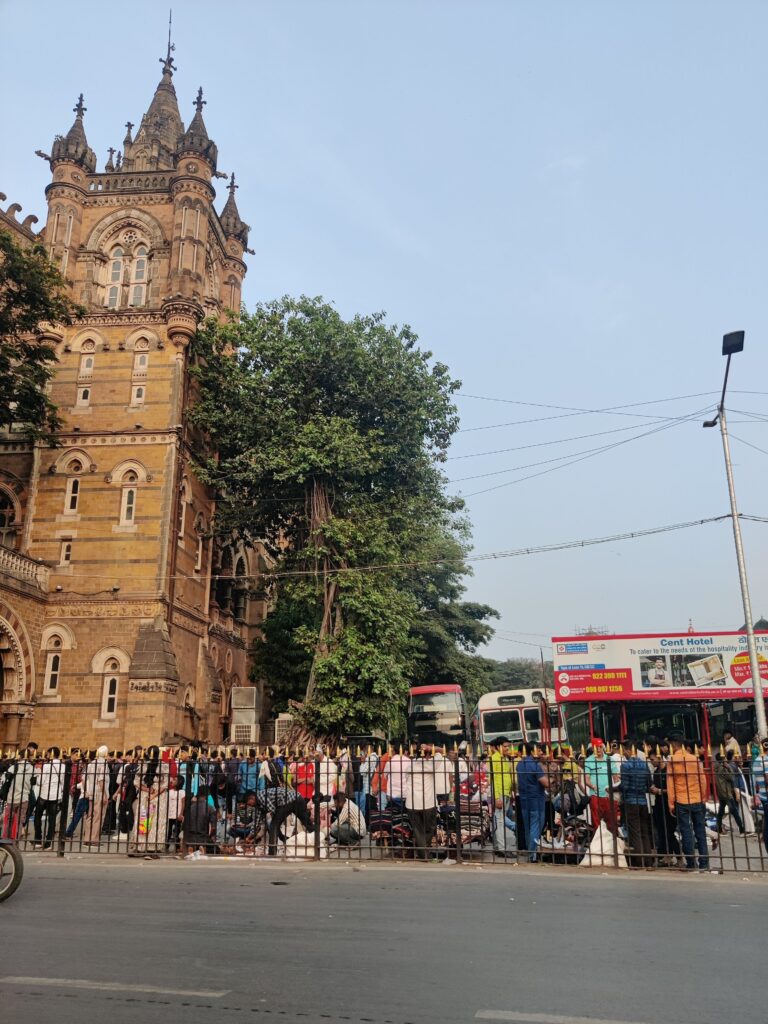
Located across from Flora Fountain is the Chhatrapati Shivaji Maharaj Terminus (formerly Victoria Terminus). At the base of this massive structure, which is devoted to sending people away, are spires rising towards the heavens, stunning works of stained glass that capture light
and colour, intricate stone carvings covering each surface, and so on – the entire building is constantly reminding us that it will be around forever.
Yet below this structure, thousands of commuters speed towards different destinations, creating their footprints in plastic containers, banging their heels against the stone floor, rushing to voice mail with cell phones. Some are running, some sleeping, allowing time to stand still, which allows the permanence of the monument and the endurance of the crowds to co-exist.
Mumbai’s genius lies in that juxtaposition.
At Marine Drive, the tide rises and falls without asking permission. At Churchgate, crowds swell and recede like a second ocean. At Flora Fountain, water continues its quiet descent no matter who governs the city. At CST, trains arrive and depart with ritualistic certainty.
And somewhere between sea-spray and chutney-stained fingers, between Gothic spires and fluorescent station boards, you realise that Mumbai is not a city you observe.
It is a city that absorbs you — tide after tide, crowd after crowd — until the hum of Marine Drive feels less like background noise and more like your own pulse syncing with it.
—————————————————————
The buses along Colaba Causeway are my favourite.
Seeing street shopping through the height of a bus window is like watching a scene from a
movie in fast forward. In neat rows, the glasses hang down from their respective displays like little disciplined suns with flashbacks of the faces passing by. The oxidised earrings catch the light. The scarves, frocks are fluttering in the breeze, brushing against the mannequins that
have chipped eyelashes. The pavement is a river of colour, the fabric, simulated silver, and the metal bangles all glow like little pieces of stained glass.
The vendors lean in, with practiced drama, to announce “fixed price hai, madam!” and then they get ready to argue with themselves. The buyers react confidently. Negotiation. The price goes up and down like the tide, someone pretends to be angry, someone else breaks into a fit of laughter, and the money all passes together respectfully, with each person being satisfied with the game they just played.
When viewed through the bus window, the entire experience is cinematic. A girl holds up a kurti to herself, and a tourist pretends to walk away and looks back. A cat sleeps under one of the racks of dresses. The stopping of traffic causes the line between bus and bazaar to be blurred.
Then the bus rolls on, and the bargaining starts up mid sentence. Causeway continues without you, vibrant and noisy, as if reminding you that in Mumbai, even shopping is a movie.
—————————————————————
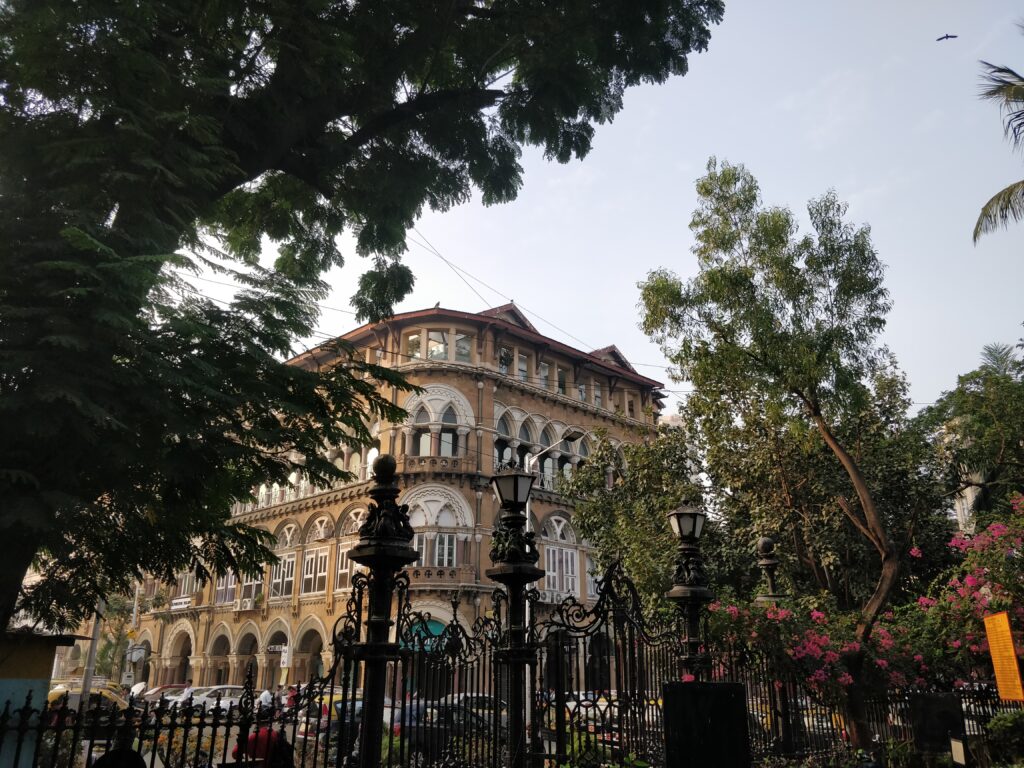
The same bus rolls towards Kala Ghoda, where art spills onto pavement. Outside Chhatrapati Shivaji Maharaj Vastu Sangrahalaya, the dome sits composed while traffic frays into impatience. Inside bookstores like Kitab Khana, I run my fingers along spines as if greeting ancestors.
Sometimes, after too much walking, we collapse into a bus without checking its route carefully.
Once, from Kamala Nehru Park, after wandering through Malabar Hill, sea wind still in our hair, we boarded an A11 hoping it would take us towards Navy Nagar.
The conductor’s response was swift and unimpressed: “Nahi chalta Afghan Church last stop hai madam”
It does not go.
Mumbai expects you to learn its grammar.
From Malabar Hill, the sea looks curated, almost obedient. The new Mumbai Coastal Road arcs deliberately against waves, engineering ambition into geography. We glimpsed the restored Opera House glowing briefly as the bus turned. Even the city’s mistakes are renovated.
—————————————————————
The taxi drivers here are philosophers!
One driver told me, “Traffic is like your fate, you may think you have control over it, but the signal has its own intentions.” Mumbai taxis run on metre, what a nice city. When you are north of the island city, auto-rickshaw drivers tell you the way to your destination as if they were narrating a story.
Bus yell as the bus lurches forward, “Aage door se utariye madam, pichhe se log andar ayenge.”
—————————————————————
At Sassoon Dock, the scent of fish is strong and will not change for anyone’s sensibility. You can see the labor here, with hands sorting the fish and voices negotiating the fish and boats back from the sea with tales of toil.
A few stops later, we are at Afghan Church, where silence ascends through stone spires. Colonial nostalgia still remains amongst trees, both partially remembered and still intact.
Mumbai changes tones in the middle of phrases.
From docks to domes; from chutney to champagne; from a cardboard bed to a penthouse looking out at the ocean.
It accommodates all of these by compressing the differences instead of smoothing the corners.
—————————————————————
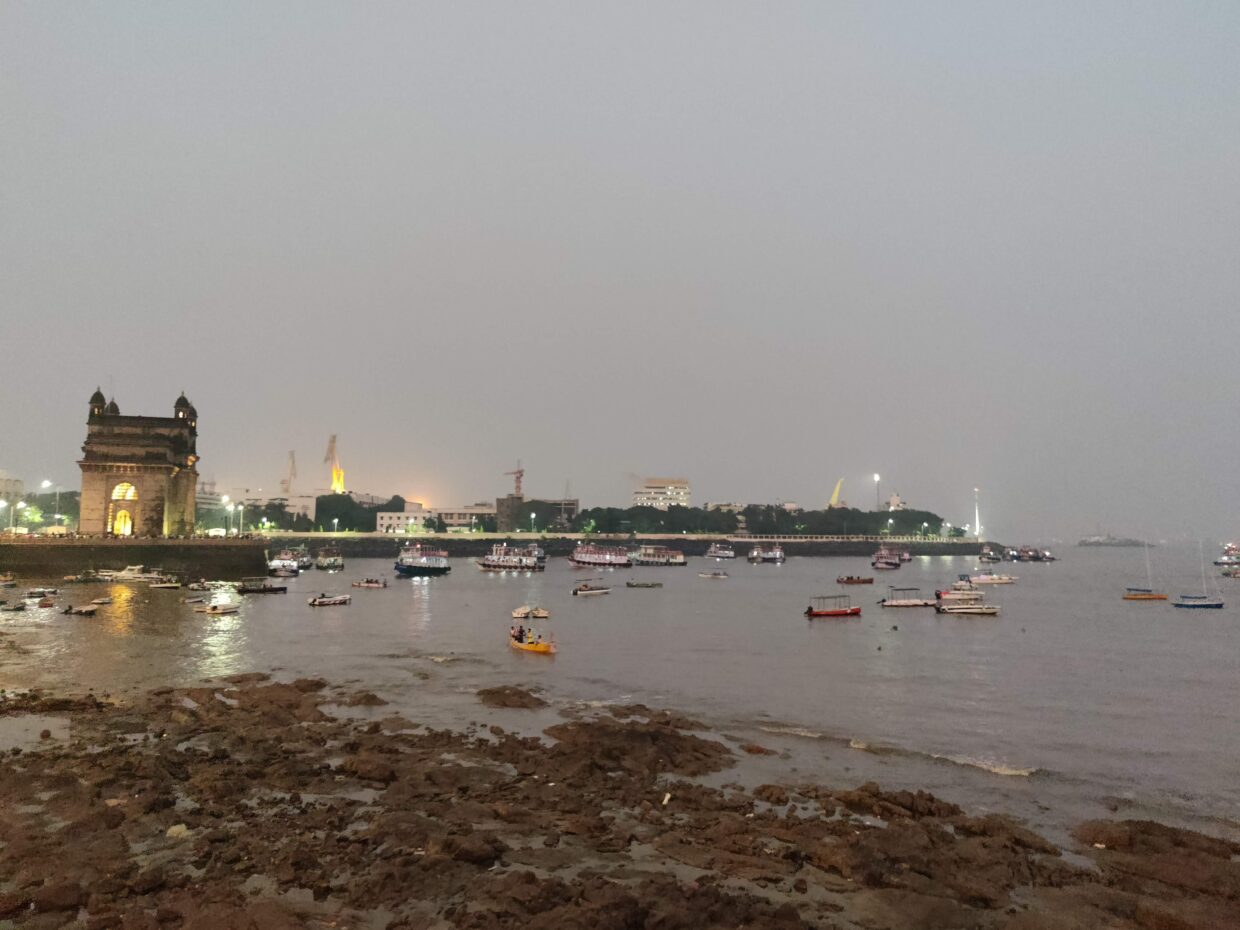
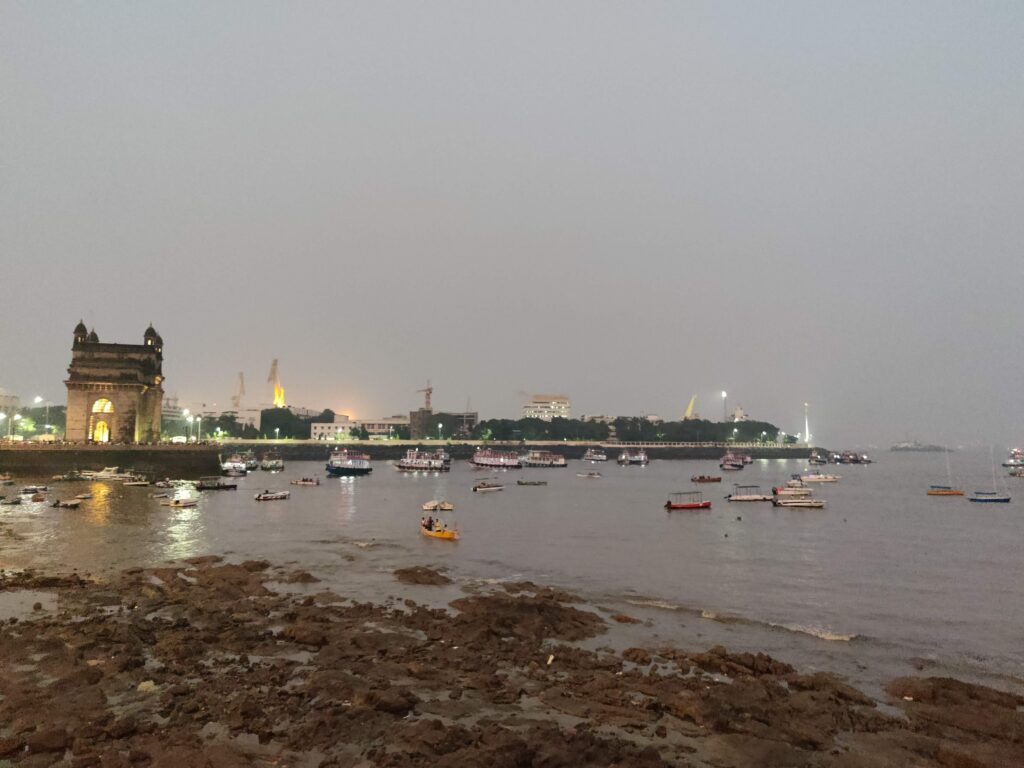
I move through Mumbai in fragments. Onion rings at Effingut Brewerkz, golden and excessive, music thudding through brick walls. Boba tea at Burma Burma, tapioca pearls startling against sweetness. Standing beneath the arch of the Gateway of India.
Mumbai.
An arcade of stories untold.
Blue skies. Sunny mornings. Sea shores. Mumbai.
A bustling network of busy streets. Shopping and bargaining.
Love echoes in the air so sweet. Mumbai.
Where freedom breathes with poetic whispers. Windy nights. Drinks in hand. Cats and Dogs. Mumbai.
The city of dreams.
With my brother, life is complete.
—————————————————————
In a bus, you are nobody and everybody.
Your reflection overlays chawls, skyscrapers, colonial facades, billboards, temples, docks. You are framed by a rectangle of scratched glass while the city functions uninterrupted.
From Navy Nagar to Causeway, Causeway to Kala Ghoda, Kala Ghoda to Churchgate, Churchgate to CST, the routes loop like recurring metaphors.
Mumbai makes you feel like a main character not because it centres you, but because it refuses to. It continues regardless.
And in that continuation, you find space. Space beside a dog on Marine Drive.
Space beside a stranger on a bus.
Space beside a colonial building that no longer frightens you.
Space to hand over the wrong currency and be corrected without cruelty. Space to get lost and still arrive.
The bus slows near Colaba.
Someone rises. Someone squeezes in. A cat darts across the road. A taxi honks impatiently. The sea glints.
I press my forehead to the window and watch Mumbai. Restless, imperfect, accommodating, alive.
The conductor signals halt. The bell rings.
And every time it rings, I belong again.


The Open Dosa Team
Latest posts by The Open Dosa Team (see all)
- The City of Dreams - 15th March 2026
- META 2026 - 10th February 2026
- Area Bois at SJU - 6th April 2023