Anandita Balasavar, from Mount Carmel College, Bengaluru, won the Mother Tongues Essay 2025 for her essay ‘Small Words, Big Worlds’. The theme for the year was ‘conversations on superstitions’, judged by Ms Shefali Mathew, who is currently the Sir Terry Pratchett Memorial Scholar at the University of South Australia. This was what the judge had to say:
Anandita’s essay ‘Small words, Big Worlds’ finds ways to talk about superstition through both the community and the individual, of the way a sisterly relationship locates itself within a world of superstitions, of moving within language and belief. Superstition becomes personal in this beautiful essay: superstition also becomes family. “My sister was a born storyteller”, the essay tells us. Anandita is also a storyteller, and one in whose words a reader can find both solace and togetherness. Moving the reader in the spaces between our internal and external worlds, this essay is both soft and strong, wistful yet joyful. A special piece.
It takes two weeks of me pondering over Lata Mangeshkar’s advanced age for her to die. February 2022, end-semester, spring day, television set. Imagine sunlight, large windows, the ruckus at Madiwala market across the road, and turn it back to fourteen years ago, in the neighbouring city of Mysore. This scene has three characters, two children, and their exasperated grandmother, set in a living room dominated by a wide wooden sofa with green upholstery.
My sister doesn’t like braiding her hair into two plaits, but she used to let Amma do it anyway. She wears it long, in a middle parting, regularly oiled—Papa says she looks like a jackfruit when she doesn’t, but she doesn’t think so. This matters because in the first scene, she’ll be small, dodging me with her hair in braids, loose and flattened after a long day at school, and I will be smaller, with two little ponytails, crying. Crying because she’s being mean, shuffling behind the sofa, crying because I can’t catch up to her. This matters because Amma used to say leaving your hair open for no reason is kali (not ka-a-li, kuh-li), which means that bad luck will come up the elevator (“Please close the door. Dayamadi gate muchchi.”) and ring the doorbell, and make itself at home. This matters because her hair is coming undone, so you know that kali is coming, half a step for every word, 158 steps a year according to a logic I am not qualified to explain.
(This matters more because I have learnt a new word from my roommate, kalesh, which means drama, who might be kali’s annoying chihuahua dog smuggled in a suitcase.)
Look to her left and you will see Papamma, who will watch over us, knowing she can’t come between our spats. Papamma will know it is futile to mediate because their systems of crime and punishment accommodate most transgressions—I hit you first (and hard), so you can hit me two times, okay? These two kids proudly tell their cousins that they don’t love each other, the younger is refused—and refuses, proudly—her sisterly right of calling her older sibling akku, which the aforementioned cousins enjoy. But this pair of siblings get along better than other kids their age, even if their fights seem to outgrow their childhood selves. Still, they insist on closing the door when they play together, they have secret names and secret codes and secret jokes, secret stories that they’ll grow to hold as secrets from each other.
This scene needs to be the first one. It will tell you two things:
- You are not a part of our story. Nobody is.
- You don’t know why we’re fighting. We won’t tell.
It will also tell you that the younger used to do little but cry. She obeys without question in fear of the elder showing her ‘things’ to their friends. ‘Things’ that hide insidiously inside a drawer, a great big secret, because my sister had declared the sight of ‘things’ as the crack in all friendships. These friends of unsteady friendship live with them in a three (+ ground) floored apartment building haunted by a ghost, she says, who threatens residents by drawing straight lines in sandpits, playgrounds, and pebbled no-mans-lands. She rules over them too, with a social contract that allows her to, among other things, name foundlings (cats and birds), decide games, invent games, and choreograph Vande Mataram dance for the apartment Independence Day programme.
***
My sister was born a storyteller. When she would be out at dance class or abacus class or tuition class, Pappa would tell me the story she used to tell them when she was a little baby so he could mash the radish in the sambar and feed it to me. In this story, my sister was a princess and had a little brother named Gautam, and they lived happily after with her mother and father. Even when retold, I would not be a part of this story.
She spoke stories for our dolls, who were named the moment they set foot into the playroom. Every night, she said, our dolls wake up and play, and talk about us. If we are unkind in the daytime, they will follow us to our beds, peek into our dreams, and watch us sleep. At sixteen, studying at 2 A.M for my political science exam, I turned the blinky doll to face the wall, afraid she might stare at me for not playing with her anymore. She says our dolls are like us, even though their hair is golden and auburn and chocolate brown, and so they must be named Alisha and Ditasha and Anita and Gautam(i), because we are named Aparajita and Anandita. But they are Not From Here, and so they are also called Alicia, and Lauria, and Judy, and Annie, and Silkie, and so we must also be called Kelly and Cathy. We work at the FBI, our household has nine humans and ten animals, one of which is a Kangaroo, and our neighbours are the criminals we catch every weekend. We live somewhere that we call Little England (in an apartment complex in Mysuru)—where the staple diet consists of tea, scones, and sandwiches—that occasionally becomes a Liliputian-Brobdingnagian alliance in a world of monarchy, elements, and tragedies. She loves Little England, so much that she’ll get a visa and take a flight and go live in Big England. I love the play room and 3PM on weekends when Ajja, Pappamma, and Pappa go to take their naps, and we play till everyone wakes up to drink their cha, after which we pick Amma up from office.
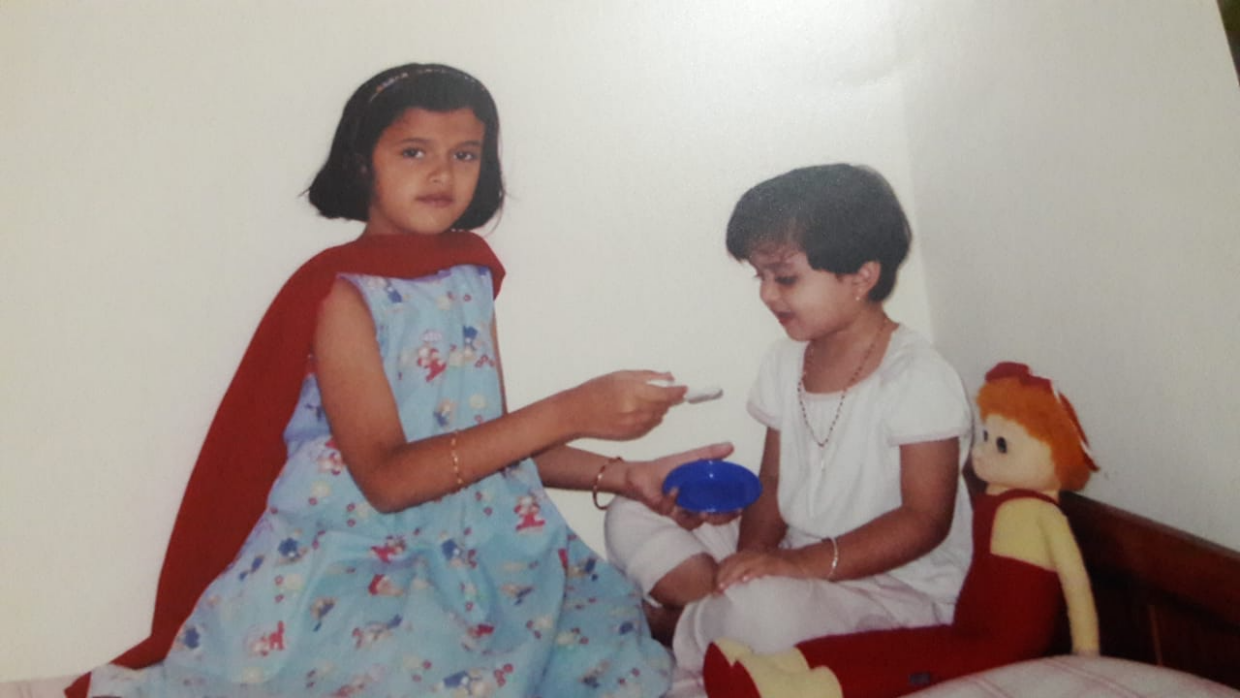
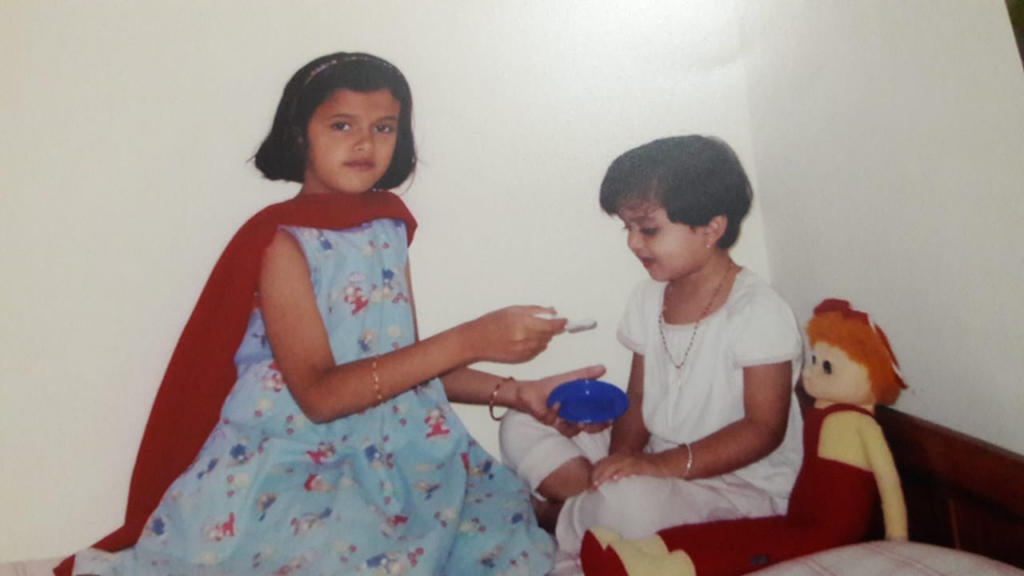
You will find a photo of her, with that red (tomato soup) ghagra’s dupatta around her neck, feeding mushroom-cut-me air from a plastic plate with a plastic spoon. You will also find me sitting cross-legged at the end of the height-order line, beside Alicia and Judy, holding Silkie’s head aloft.
We speak our games in English. I speak my words as echoes of hers, becoming part of the story like Cathy from FBI, like Genevieve from Small Land, like Meow the Cat, whoever, whatever. Far ahead in time, you will squint and find Amma speaking to me, frustrated. Ever since Big Sister has gone to Big (Ben) Land, she’s always speaking in English, English, English—accented, because I’m going to make fun of her for always gobbling up her Rs—and Amma can’t get a word through in Konkani. By this time, she’ll have been gobbling up my name for a few years already—An-ta—ending. This matters because our names matter, Aparajita which makes her undefeatable, ever-victorious, and Anandita makes me the one who gives, tries, and strives towards happiness. The one who wonders if Anandita is Anandita, or just waiting for the An-ta. Ha ha.
***
The superstitions of our household are adopted as unhappy accidents. If you keep a rubberband on while getting drenched in the rain, your head will be full of lice. If you leave your long, dark, voluminous, hair open, bad luck will knock on the door, and give you the sort of hair fall that’ll increase with stress and cause even more hair fall. You will be so stressed that your family won’t take you seriously and will laugh at you, and kali will become kalesh because you will resent them forever. If your little sister blows raspberries at you, you’ll end up with angry red boils on your face. She will laugh and call you a tilla oondo because you’re pimpled and spotty, and five years later, will pick at her own pimpled, spotty skin. You will learn from these superstitions and start making some of your own, and because you are a woman in STEM, these will be cold, hard facts to you and by extension, to your little sister.
One spring, studying for your board exams, you will blow up at her because she’ll blow up at you and divine that your maths paper will suck. It will suck, but you won’t know that yet. What you will know is that anything that can go wrong will go wrong, especially if your younger sister says so. You will sit seething as careless words fester in the margins of your RS Aggarwal, getting squashed under your ballpoint pen as you work out the probabilities of everything.
You will keep me afraid of the ghosts you tell me stories of. The one that sneakily unlatches windows on Delhi winter nights, letting in a bitterly cold draft, who might be the same one who pushes heavy encyclopedias off bookshelves when we’re home alone. Maybe that one, the little grey Gollum boy who pats your feverish forehead, making it throb, who will push you into the dream where you jump off the school building because you got only 80% in the boards. The one in the nightmare where cash is the only real currency in the world and your sister is a stubborn English major.
These will all be snippets strung along a long red thread between you and me. This will be a good nine years after Pappa will tell me not to snip-snip-snip idly with scissors because that cuts off family ties. This will be a good fourteen years after Pappa will have told me about the nameless tathaastu god who is always listening, always granting petty wishes, and heartfelt curses, making everything happen in continuous future tenses. He will peep into my thoughts about Lata Mangeshkar growing old, and hear me say “I hope you fail your maths exam!” to my anxiety-prone older sister, and construct in the idle snips of a kitchen scissor an incessant whisper of “I want us to grow apart.”
So, he will listen when she speaks her English story about Little England, and fly her out to Big England. So, he will see me standing helpless in the living room of the Mysore flat, waiting for her to stop dodging behind the wood-and-green sofa, and decide that the little(r) one doesn’t bother chasing long enough. When she leaves home the first time, we will not know how to speak our goodbyes; the second, we won’t realise when to say it. We will talk once a year, and they will, at some point, sound very angry. We will prefer to text and forget to reply.
But before the scissors have snipped a third snip, before kali has rung the bell, before the tathaastu god has started listening to angry little girls, we will have been two sisters scorched on a sunny summer day in Hampi—her grown up, me almost done growing up—both grown red and charred, angry flushes across our noses, over our shoulders. This matters because we’ve both forgotten to wear sunscreen and we’ve both ended up with sunburns.
***


Anandita Balsavar
Latest posts by Anandita Balsavar (see all)
- Small Words, Big Worlds - 27th January 2026
- The Weight of Everything - 6th June 2022